Sunday, June 23, 2013

We're ln!


The Derecho--from the bathhouse window

Finally, Bel Canto is in the water and we are living (more or less) aboard. We were both excited to be spending our first night as actual liveaboard sailors! Jim was sure that he would get his first good night's sleep, without worrying about the next problem we were going to run into trying to get our boat ready. It seemed like every time we turned around, something new would crop up to delay us. Like when the electrician who was attaching all of the wiring from our newly rigged mast pointed out a through hull fitting, called a seacock, that looked like it wasn't seated properly. (A through hull is a hole in the bottom of the boat for water intake or outgo. If the fitting, valve, or hose connected to it fails, your boat begins to fill up with water and could sink.) He could move it with his hand. He said we'd better have it checked out while the boat was still “on the hard” (i.e., out of the water). So we called in Ted, owner of Seaside Marine, to give us his opinion. Ted took one look and began singing a requiem for drowned sailors. The seacock had been put into a hole that was too big for it, with 5200, a high grade marine putty, used to fill the gap. (Make up your own jokes.) It could have been okay for years before it began to leak, but then again . . . The solution was to take out the fitting, fiberglass the hole, then drill a new hole the right size, and reseat the fitting. This involved about five people and ended up costing us a whole boat unit ($1000).

So the mast was stepped, the through hull fixed, the stuffing box repacked, and we were ready to launch. The launching went without a hitch, with the owner of the boatyard himself towing Bel Canto to her temporary berth at the end of the pier. We had to be towed because Chris, the engine mechanic still had some adjustments to do on the engine. We moved a bunch of stuff from our car, where it had been sitting for more than a week while we moteled it, to the boat. Meanwhile, another Tayana 42 had come in and docked at the pier across from us. We went over to chat with them and ended up on their boat for “cocktail hour,” (sometimes referred to as sundown g & t). When we got back to our boat, the alarm indicating too much water in the bilge was ringing. We checked the stuffing box, and instead of the two to six drips a minute that were supposed to be coming in to lubricate the propeller shaft, a steady stream was flowing into the boat. To top it off, the automatic bilge pump which was supposed to react to problems like that wasn't working, and the switch had to be operated manually. So we were awake every hour pumping out the bilge. We got a great night's sleep the second night, though, and last night we sat in the cockpit under the light of the full moon, on our new cockpit cushions, delivered yesterday, listening to music from our cockpit speakers, and cooled by the gentle breezes that had come up after a near 90 degree day. Even though we are still in Bert Jabin's Boatyard, we could have been in the islands.

How many does it take to . . .

How many people does it take to get Bel Canto ready to sail? Well, there's Rob, who has been helping us all along. Then there's Dave, the rigger, and his helpers, Tyler and Tom, Richard, the electician and his partner, John, Mike, the diver, Ann, in charge of the bottom painting, and her two workers, Chris, the engine guy, Sean, the canvas guy, and on and on. Our count was up to twenty when Richard found the problem with the through hull fitting. That brought in Ted and his helpers, Todd, Brendan, Brian, and Benjamin, and a couple of others whose names we've forgotten.
Richard Kralok, our electrician

We had planned to go into the water a week ago last Tuesday after the mast was stepped. Then it was put off until Thursday so that the electrician who was rewiring all of the instruments could finish his job. Of course, his job was made harder by the fact that all kinds of things had been added over the years, and much of the wiring was unorthodox, to say the least. And nothing obsolete had ever been removed, so the electrical system was quite a jumble. Then the electrician noticed the faulty throughhull fitting. So then we had a hole in the bottom of the boat and an expected launch date of the next Monday. Some of the guys working for us are getting a hundred bucks an hour, so the old joke about a boat being a hole in the water into which you throw money and watch it disappear is hitting uncomfortably close to home. One of the sailors here at the marina says you have to count boat units instead of dollars, each boat unit being a grand, and it doesn't hurt so much. It seems like we get one problem fixed and we find something else that has to be done. I (Angie) think about the Tennessee Ernie Ford song that my father used to sing—Sixteen tons and what do you get? Another day older and deeper in debt.

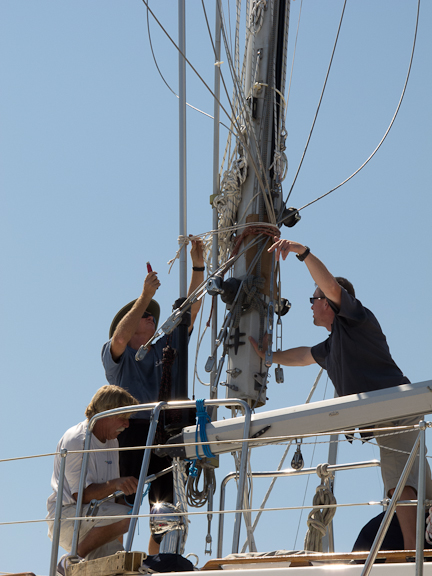
David van der Spuy, rigger
It turned out to be a good thing that we didn't go in the water on Thursday, since the derecho came through in two waves, one in the morning and one in the afternoon, with wind gusts that we judged to be at least 60 mph. Todd had warned us to get out of the boatyard because boats sometimes toppled over in a storm. We took refuge in the bath house, in the men's bathroom because it had no windows. (In my younger years I had a reputation for hanging out in the men's bathroom--Angie) But Richard stayed on the boat, finishing up the wiring.

But now we're in the water and able to enjoy living aboard Bel Canto, even though we're sitting at the dock in a marina. Friday Tom (We'll have to tell you more about Tom later—he is quite a character) helped us get the sails back on. We figure we're about 90 % ready to sail away, at least out to the middle of Back Creek, where we can anchor for free. And then we will be able to go out into the bay and practice handling the boat under power and sail. Hoorah!

Tom Yoho, all around handyman


Mast on the hoist--going back!
"Easy, there!"
Now where do these go?
Back to the water.
Rod Jabin, boatyard owner, hooks on to the bow

A little help from our friends


Angie swabbing the deck with a toothbrush (in the rain)
Liquid Energy


Friday, May 24, 2013

Poco a Poco


Can you imagine us in a tropical lagoon, lying on the deck of Bel Canto, the boat gently rocking in the breeze, as we watch the the man-of-war birds swooping over the palm trees on shore and sip our rum and pineapple juice concoctions, the faint sounds of reggae from the natives wafting over the bay? Or perhaps ghosting along over gentle ocean swells, the white sails looking like a seabird's wing extending up over the blue hull, listening to the murmur of the wake as the boat cuts through the water.

That's not us. The boat is in the boatyard, on dry land, propped up on jacks, while her mast lies 200
Bel Canto "On the Hard" and unmasted
yards away. Shortly after we arrived home from our last work session in Annapolis, we got an email from David van der Spuy, our South African rigger, that the mast was coming down and he was ready to start measuring for new standing rigging (remember, the cables that hold the mast to the boat and keep it from tumbling down?) We wanted to see for ourselves that all this was really necessary, so we piled back into the Honda, loaded down with stuff that we will need if we ever do get under way, and headed back to Annapolis. The boatyard is sometimes facetiously, but accurately, referred to as “the dust bowl.” Dust from boat bottoms being sanded before the copper bottom paint, toxic to sea life and humans, is applied, and dust from fiberglass being ground down for repairs to damaged hulls settles over everything.

Looking over the rigging, we were convinced that David was right about most, if not all, of it. The inner forestay, a cable that runs from the deck in front of the mast about 2/3 of the way up the mast and to which the staysail is attached, was half severed at the upper end. This stay isn't essential for holding the mast in place, but two of the shrouds holding the mast latterly had broken strands, and many of the other stays, while seeming sound, showed rust. We decided that the prudent thing to do was to follow David's recommendation and replace all of the standing rigging that was original with the boat, hoping that when it came time to sell the boat, this would be a strong selling point.
Dave and Jim examining the rigging

Angie: We met Dave at the boatyard on Saturday morning to help him remove the rigging and measure it to order new. If we hadn't done it he would have had to hire someone else, so we figured between us we were earning $25 an hour. That's better than we had been making.  Part of our job was removing the halyards (used to raise the sails) and topping lifts (used to control the boom and spinnaker pole) from the mast. These run up inside the mast, so we had to run messenger lines up as we pulled them out so that we'd be able to get the new ones back where they belonged. While we worked, we talked (can you imagine?), and I learned all about Dave. He is descended from Afrikaners, the Dutch settlers in South Africa. They spoke a form of Dutch called Afrikaans, and some of Dave's speech patterns and sayings come from that. For instance, he said that if we were to put an eye splice in the end of one of the lines, it would end up looking like a pig's breakfast. The Afrikaners hated the English South Africans, who they thought were trying to gobble up everything for themselves. Dave's mother is English, straight from England, so I guess his father got over the hating. It was fun working with Dave. He has an upbeat personality and makes us feel better about all of the work we are doing. He's says she's a beautiful boat and we'll have great fun with her when we get these major jobs out of the way.
Getting the prop ready to paint

Getting back to Annapolis enabled us to coordinate the work that still had to be done on the boat. We talked to Ann Miller, who was supervising the bottom painting, and Sean, who came out to measure for the new dodger (he's also making the new cushions for the vee birth). And when we saw the mast down, we decided we needed all new wiring that runs up inside the mast to and from the mast lights, the radar, the wind instruments, and the radio/tv antenna. Some of these were undersized for the length of the mast, and some showed signs of wear and were liable to fail. So we got hold of an electrician and went over all the electrical jobs to be done with him. Chris Oliver, the engine guy, came and finished working on the engine, except for a few tests and adjustments that have to be done once the boat is back in the water.

Cutting line for new fenders
Angie: Meanwhile we continued putting our things on the boat and trying to get it settled. This is really hard, because the vee birth is full of sails, and the solar panel, which came off the dodger so that it could be measured, is lying in the quarter birth. These are the two main cabins of the boat, and it makes it hard to settle these areas. And the galley is still partially disassembled, because you have to take that apart to get at the engine. Everything that goes on the boat has to come up the 15 foot ladder. I must climb the ladder 20 times a day. I don't think I've been on a ladder that many times in my whole life before, but I'm getting used to it.
In fact, I started cleaning and repairing a section of the rub rail that runs around the hull. To do that, I had to keep moving the ladder around the boat in addition to climbing up and down. It's no wonder that I'm exhausted at the end of the day! In my spare time (like when we're traveling back and forth to work in the car) I practice tying knots. I learned some essential sailor knots when we were on Escapade, but I'm more into it now. Jim just taught me how to tie a clove hitch around a piling. He said that when I get really good at it I'll be able to tie it around the piling from six feet away, and that will impress everybody. I've seen him do it, but I'm not sure I'll ever be able to.

We have been taking time to relax once in a while, mainly by going out to eat. We discovered a great breakfast place, 49 West, that has the atmosphere of a sixties coffee shop. They have great coffee and excellent quiche. That helps us not miss our Sunday brunches at the \AUT\ so much. We also stop in at night sometimes for chocolate covered almond biscotti and cappuccino. Our favorite place to eat is a Thai restaurant called Lemongrass. They have a great happy hour—all wine by the glass and hors d'oeuvres for five dollars, and their seafood dishes are out of this world! We've had dinner—three hors d'oeuvres, a main dish, and a bottle of wine—for less than going out for a snack costs us in Ann Arbor.
Steamed dumplings at Lemongrass

Two jobs we still have to get done before the boat hits the water is to repack the stuffing box and to fix a switch on the automatic bilge pump. The stuffing box is what keeps the water from gushing into the boat where the propeller shaft goes through the hull, and the bilge pump is, of course, what pumps out the water that does seep in. The list seems to go on forever, but we are making progress, little by little. And we passed one huge milestone. Just before we left Annapolis, the graphics people came out to put the new name on the boat. And yesterday we heard from the Coast Guard that the documentation, which makes the name official and also certifies her as our boat, was just completed. Here she is.

Saturday, May 11, 2013

And the Beat Goes On . . .


May 10, 2013

Things a person must do before buying a 28 year old boat:
Get a thorough survey of the boat and read it carefully.
Get a survey of the standing and running rigging.
Get an engine survey.

We arrived at the boat on May 3, with a load of personal gear and equipment, ready to start replacing the 30 bags of stuff that the previous owner had left aboard with our own belongings, a major step in transforming Outrageous into Bel Canto. When we checked our messages before heading for the boat, we found one from David van der Spuy, the man we had chosen, at Tyler's recommendation, to check out the rigging, informing us that he and Tyler would be at the boat at nine o'clock to do the inspection.

Dave working 5 stories up on the mast
David is a fascinating guy, a South African, slight of build and wiry, with a thick South African accent. After explaining to us what he was going to do, he strapped himself into the bosun's chair, attached the mainsail halyard to himself like an umbilical cord, and had Tyler begin winching him up the mast. Soon he was swinging around atop the 54 foot mast like an acrobat, calling notes to Tyler as he looked at every wire and fitting, from the mast top to the spreaders, and on down. He found several shrouds with broken strands, corroded fittings. 

His final report was not encouraging. He recommended totally replacing the rig, except for the headstay, which had been replaced fairly recently. We should have been prepared for this. Some people recommend replacing the standing rigging (shrouds and guys that hold up the mast) every ten years, and just about everybody agrees that you shouldn't trust it for more than twenty. From a safety standpoint the standing rigging is the most important part of the boat. If a shroud or stay breaks, the mast can come down. And in any kind of a sea, the mast in the water, still attached to the boat by all of the wires that did not break, can wreak havoc, even to putting a hole through the hull and sinking the boat. 

The report on the running rigging was just as bad. The halyards which are used for raising the sails, and most of the sheets and other control lines, had been left on the boat while she had been in storage at the owner's dock for the previous four years. Superficially, they looked great. Many were comparatively new. But almost all of them had spots where they had been exposed to water and weather, and these spots were mildewed and in some cases rotted. Lines used for running rigging are expensive. They must be strong, but soft enough to allow the crew to handle them comfortably. Like the wire rigging, most of the lines and the boat must be replaced. Dave demurred from giving us an estimate on how much all of this was going to cost until he had worked out a plan of action and priced out parts. Our 3 a.m. worry that night was that the cost of re-rigging might exceed the value of the boat. 

Meanwhile, we went ahead getting the boat ready to be hauled from the water for the bottom work. On Monday, the appointed day, Grover and Rob met us at the boatyard (so that we would have transportation once we arrived there with the boat), and we piled into the Honda and headed back to Grover's. It took an hour or so to get the boat ready to leave the dock. 

I wanted to handle the boat myself, but Grover convinced me that leaving his slip in the shallow creek was tricky, and that he should handle that part of it. As we pulled out, he demonstrated how by turning the wheel just so and gunning the engine in sync, you could get the boat to turn in it's own length. 

From that point on, Grover stood by giving me tips on how to handle a 33000 pound boat, and Rob, the great guy who has been doing some work for us, helped Angie handle lines. The four mile passage down the Severn River from Grover's dock to Back Creek and Bert Jabin's Boatyard was easy. I just had to steer the boat in a straight line from point to point. We were motoring because the object was to get to the boatyard, not enjoy the ride. And the slight drizzle would have taken the fun out of sailing anyway. But I was scared nearly shitless when I learned that I had to bring the boat in between two wharves with barely more distance between them than Bel Canto is long, especially when the dock hands instructed us to turn around in there in order to have the stern facing the hoist. 

Angie: We'd called ahead on the cell phone to let the yard know that we were coming in, and there were two workers coming out on the wharf to meet us. They yelled that we had to turn the boat around. I looked at the space and asked Rob, “Can we do this?” Now you have to know that this boat weighs 16 tons. That's a lot of boat to maneuver—about like driving a semi-truck. My job was handling the lines on the bow while the worker on the dock yelled out what we should do.

Jim: Grover told me to turn wide but be careful because she pivots near the stern. I nearly blew it by turning the wheel the wrong way at first, but then I corrected and gunned it and she turned on a dime, just as Grover had said she would. The stern swung a few feet from the wharf on the port side. The guys on the other wharf, where we were heading were yelling at me to slow down, so I threw her into reverse and gunned her. The dock worker reached out and stopped her with one hand and the prop rotation pulled the stern over to port. Everybody said it was a perfect docking, done like a pro, but I knew that I was just damned lucky!

On Wednesday we received Dave's estimate by email. It was bad, but not quite as bad as we feared. To make the necessary repairs and modifications to the rigging was going to cost $12000, more than a third of what we had set aside for all the repairs, additions, and other expenses we had planned for in getting the boat ready to sail.

Angie: (Wednesday, May 8) Another eight hour day working on Bel Canto. She's now in the yard, resting on her keel, braced by stanchions that keep her from falling over. So now we've traded a long ladder to board her for the 60 steps and Grover's steep trail. Yesterday we had monsoon rains and didn't get much done on the boat, but today is beautiful—cool, blue sky, light breezes—a perfect day to take the sails down. Oh, did we mention that the sails that we were so happy to get up the last time we were here had to come down again? Jim was awake a 3 a.m. the day we brought her over here worrying about how and when we were going to do that if it was necessary. Now we have some really big sails, especially the mainsail and the genoa (foresail). Together they would just about cover the floor space in our house. My trust level is really low, so when Jim said, “Let's take the sails down,” I envisioned a gust of wind toppling the boat over onto our car, or worse, onto the two brand new sailboats next to us. Our million dollars of liability insurance wouldn't cover the damages, to say nothing of fact that we would probably be severely injured or possibly die. Jim is a good teacher and has lots of sailing experience, but did I really trust him that it was safe to do this? Usually I just dive in and do what has to be done, but I was really nervous about this. But I knew that we had to do it because we were leaving tomorrow, and the sails had to come off for the mast to come down, and the mast had to come down for the rigger to do his job.

"On the hard" and ready for her new name

Jim: We lucked out on the weather. Taking down the sails would have been dangerous if there had been much wind from any direction but dead ahead. You see, the sails had to be raised in order to take them down because they come off the track starting at the bottom. But fortunately the breezes were gentle and right on the nose. 
 
Angie: We worked a good two and a half hours doing this. We had to sort out all the lines and halyards, and there are many, but we got the sails down and we were very proud of ourselves. After we got the sails down on deck we had to fold each one (there are three), because we had to store them inside the boat. You start by folding them like an accordion. The nautical term is flaking. After they were flaked, we rolled them up, tied them, and struggled to get them below decks. The biggest sail must weigh about 80 pounds. 
 
As we were stowing the sails, Ann Miller, who will be supervising the painting of Bel Canto's bottom, showed up. The keel is a reddish orange color now, and my main concern wasn't how much work the keel needed, or how much money it was going to cost (I let Jim worry about that). It was, “What are our choices of colors?” We all have our priorities, and I am bound and determined that we are going to make Bel Canto not only the best sailing vessel possible, but also the most beautiful. We finally decided on black for the bottom paint. It won't be visible except when we are sailing and heeled over a bit, but it will go well with the deep blue hull and red accents. 
 
When Ann left I thought I would settle down with my Kindle, take it easy for a while, and read. Dream on Banjo Picker. Did I actually think the captain would allow me to rest while he was working? Jim had been removing the name Outrageous from both sides of the stern when Ann came. To do this he had to balance on the ladder, using a heat gun (something like a hairdryer) to heat up the vinyl letters so he could peel them off. This left a sticky gunk, which he had to saturate with Goo Gone and then scrape off with a plastic putty knife. It was hard, tedious work. He was getting ready to go back to this when he saw me with the Kindle. “I'm sure you can find something that needs to be done if you look around,” he commented. I could and did. 
Beginning to make her ours with Sarah's spoons


Getting an older boat ready to sail and live aboard is a lot like what happens when you buy an older house, or as Jim says, when you get married. There are always a few surprises and things you don't anticipate, and some of them can be quite costly. As we were on our way back to Ann Arbor, we got a call from Chris Oliver, who was working on our engine. The heat exchanger, which cools the engine by transferring heat from fresh to salt water, has to be replaced. That's going to be another couple of thousand dollar bills. I have to say that this has been a challenging project, not to mention an expensive one. But we are having fun working together and still eagerly looking forward to when we can move aboard and set sail.

Tuesday, April 23, 2013

"Little did we know . . ."


Little did we know what it was going to take to get Outrageous ready to sail and to turn her into our boat!

Cutting away Outrageous's winter coat
We are in Annapolis, working 6 to 10 hours a day on the boat. (On the “short” days, we spend several hours running around Annapolis picking up stuff we need.) The boat hasn't been sailed for four years, and for four years dirt has been accumulating. I have never done so much cleaning, polishing, scrubbing, and painting, and placing my body in weird positions to do it all. We don't have to go to the gym. The boat is still at the previous owner's dock, in Saltworks Creek at Annapolis. Sixty steps lead down a steep hill to his dock, and we negotiate these several times each day. At night, we drag ourselves to our hotel room, too tired for a night out on the town or to play the games (scrabble, chess) that we brought along to keep ourselves from getting bored.


The previous, original owner of the boat is a really neat guy. (You met Grover in a previous blog.) After we bought the boat, he had it shrink wrapped and kept it heated until we were able to come and begin working on it. And he's letting us keep it at his dock free while we get it ready to go to sea again. But Grover is a bit of a pack rat. He tells us he can't bring himself to throw away a bit of line (rope to you landlubbers), and I believe him. You never know when you might need some! And he had spares for the spares for the spares. He had prepared himself and the boat for extended cruising in remote parts of the world, and he wanted to be entirely self sufficient. I'm pretty sure that whenever he replaced an old part with a new one, he kept the old, just in case he might have to piece something together sometime. It added up to 25 years of accumulated gear, spare parts, and such. All well and good, but Jim and I wouldn't know what to do with most of the stuff, and besides we have to make room for our own junk. Also, there were multiple books on every nautical topic and dozens of VCR tapes for a TV/video player which we also threw out.

So we've been up to our . . . ears in work, going through drawer after drawer and locker after locker, sorting through stuff and trying to decide what to keep and what to get rid of. I never knew that you could store so much on a boat. The first day of this (our second day here) we got rid of 12 big garbage bags full of stuff. After a few days of this, it began to get real discouraging. But then we just decided that what had to go, had to go, and if we found out later that we needed something, we'd just have to buy it. Every once in a while Grover will come across something we are throwing out and say, “Do you really want to get rid of this?” Sometimes we keep it. We ended up carting away over twenty five bags of stuff. Fortunately there's a trail from the boat up to the road, and Grover loaned us his golf cart to get stuff up the hill, so we didn't have to haul it all up the stairs. But taking the golf cart up and down the steep trail is as thrilling as a carnival ride.

When we're not cleaning and sorting and throwing things away we are running around Annapolis shopping for marine items and talking and working with the people who specialize in some aspect of boating, e.g., graphics, engines, electrical work, dodgers (the boat's windshield), cushions, bottom painting, etc. It's real easy to spend money on this project. The old saying is that if you want to know what sailing is like, just stand in a cold shower and tear up $100 bills. We're finding out what the tearing up bills part is like. Only, it could be $1000 dollar bills!

We are getting daily inservice training on the mechanics of the boat, including marine toilet, diesel engine, bilge pumps, water tanks, refrigeration, and on and on. We have a crew of experts working on the engine, rigging, and the canvas. Our sails have gone to the sailmaker's to be checked, repaired where necessary, and washed. We've even had our 120 gallons of diesel fuel polished. And Grover comes around every afternoon, after managing his four coffee shops (and remember, Grover is 81 years old) to answer questions and help us out. Some day we may even be able to sail the boat.

There are several things that have to be done that don't exactly take an expert, but they do take knowhow and time, both of which we have too little of. Things like installing a new water pressure tank or a vent hose to the diesel stove. To our great fortune, Grover introduced us to someone who is has quite a bit of both (knowhow and time). Rob Sutherland has owned boats all of his life and lived aboard for seventeen years. Compared to Jim, he's a young man (only 64) and can crawl into spaces that are getting a bit difficult for Jim. He's already helped us out a lot and will continue working on the boat while we are in Ann Arbor. Thank the gods for Rob!
Spring arrived while we were here!

We haven't tackled the technology side of things yet. One addition we'll be making is a chart plotter. It's a little screen, usually by the boat's wheel, that shows the nautical chart (i.e., map) and a little icon that shows where the boat is. Some sailors have actually sunk their boats steering the icon on the chart plotter instead of looking where their boats were in the water. Sailors talk about having a satellite phone to the tune of $1500 plus $50 dollars a month for about 10 minutes of talking if you are sinking. We decided that we'll just sink and not spend the money. We will have a life raft and an EPIRB that gives off a signal that tells someone where you were when your ship went down. I'm not sure who that someone is.

We're getting things under control, though. We can see the light at the end of the tunnel, and the boat will be beautiful when we get done with her. And we are having fun, even if we are exhausted at the end of the day. Jim says he never could have taken on this project without me. He says I'm the driving force. We're nearly done with this phase of our work and easing off a bit. Jim is out on the dock washing sheets (the lines that go to the sails). He says he will do the pillow cases next.

On our next trip here Outrageous will be taken to the boatyard and hauled out of the water to have her bottom done and for a few other jobs that have to be done while she is “on the hard,” as sailors say. One of those jobs will be to peel off her old name. Outrageous doesn't quite fit Jim's and my feelings about who we want her to be. The new name she will sport on her stern quarters will be BEL CANTO, Italian for beautiful song or beautiful singing. Home port, ANN ARBOR, MI.

Sails back on, ready to go!


Sunday, March 17, 2013

Swimming Lessons


A FAQ (frequently asked question, for those of you who have only used a computer for a week) we get when people hear that we are going off on a one to three year ocean sailing trip is “Do you know how to swim?” Well, the truth is that I've just sent away for a 10 lesson, self-coaching, learn to swim program. But not because I think that swimming is going to save my life if I accidentally fall overboard or if the boat sinks. First of all, if you go overboard in a storm, say with 50 knot winds and 8 foot seas, no amount of swimming is going to save you, even if you are Mark Spitz. Second, if you fall aboard while, say, using the rail to save a trip below to the head, as males are wont to do, you won't be able to swim fast enough to catch up to the boat, and you'll be too far from shore (think 10-200 miles) to make it that way. So the way you prevent that catastrophe is to wear an inflatable life vest at all times that a trip overboard is even remotely possible and, in extreme conditions, keep yourself tethered to the boat. Besides, though I am a lousy swimmer, I'm not afraid of the water, and I can keep myself afloat almost indefinitely by turning myself into a jellyfish (try it in a pool sometime) and raising my head out of the water only for taking in each breath.

Knowing how to swim won't help you here!

So why the swimming lessons? I grew up around the water, a few miles from Lake Michigan, and a mile or so from Mona Lake, near Muskegon, Michigan. Both were frequent destinations for me and my brothers and friends, and sometimes for the whole family, when I was a kid. I loved the water, but never mastered enough swimming technique to do more than the 20 yards or so to make it to the swim raft. As I recall, my two older brothers were quite good swimmers. I think they got their technique in the swim classes we were required to take in high school. That didn't work for me. Maybe because we had to swim in the nude, and my outstanding memory of that was my swim instructor, a typical (for that era) overweight ex-jock, asking me, as I was getting dressed in the locker room after swim class, why I thought that I needed to wear a jock strap. Needless to say, though I remember his name today, he didn't become one of my favorite teachers.

So what's a (nearly) 77 year old guy doing trying to achieve something that has eluded him for almost three quarters of a century? Well, for one thing, age doesn't deter me. I was well into my fifties when I became a proficient white water paddler in an open boat canoe. I was just shy of my 60th birthday when I learned to ice skate (another skill that my older brothers picked up, but that I somehow missed out on), and I became a pretty decent skater. I kept that up until a two foot high kid tried to skate between my legs in a crowded ice rink and sent me crashing to the ice. It was a year before the pain in my hip was gone, and that may have been why I needed physical therapy to strengthen my leg muscles now. The kicker was that I ran across a reference (in a book on cooking, of all things) to the Total Immersion method of becoming a competent swimmer. It promises to show you how to swim efficiently without tiresome drills and roadblocks like flutter-kicking a board from one end of the pool to another, in 10 easy lessons. I've bought my swim cap and goggles and tomorrow I hit the pool. We'll see how it goes!


Sunday, March 10, 2013

Getting Fit


Stepping the mast after transiting the Erie Canal
Once we decided we were really going to do the cruising thing, I began pouring on the steam in my personal fitness routine. It wasn't enough just to keep moving. I figured I was pretty fit for an old guy, but I wanted to be sure that I had enough strength and stamina to handle a 42 foot sailboat. I upped the ante on the weights and aerobic exercises. I even went so far as to go to a physical therapist to strengthen a knee that once in a while felt like it might give out on me. This was all going very well. Then one day, lying on the mat at the gym doing some exercise which was supposed to strengthen my butt muscles (the therapist said this would help my knees) I happened to catch sight of loose, wrinkled skin hanging from the crook of my arm. My god, I thought, that's just what an old man's arm looks like. That can't be me! The sight was made worse by the fact that I had been going through slides taken on our year aboard Escapade, 27 years ago. While I was never what you would call a hunk—I had what in my school days was described as an isomorphic rather that a mesomorphic build (you young ones, look it up!)--I still thought I looked pretty buff in the pictures.


Jim and Dennis Kittel displaying their catch
That image was enhanced by the fact that my slender but well toned body sported what in those days we called a healthy tan. Ever since the day while walking along the beach in Barra de Navidad, Mexico, I started getting little rosettes on my arms from the sun, I haven't dared expose them to much sunlight. That, and the fact that I've already had a squamous cell carcinoma removed from one ear (ending my dreams of becoming a movie idol) means that I'm going to have to keep my body pretty well covered while we re-explore the island paradises. Angie says that's probably a good thing.


Angie wearing her Bahamas tan


Thursday, March 7, 2013

Tribute to Warry

-->

To us, Maruata is Paradise on the Pacific. A small indigenous village on the coast of Michoacan, Mexico, it has somehow escaped the ravages of modernity. It accommodates tourists, but only those willing to sleep in a simple wooden hut, or to rent a hammock under a palapa, or who have an RV small enough to negotiate the dirt track that leads to the beach front encampment. We found our way in driving Howie, our 1990 Ford cargo van in which we had been touring Mexico. We had no idea where we were going, but along the way someone told us to “just ask for Warry.” We finally spotted a stubby blue school bus inside a fenced off compound. A stocky, greying, bearded man with a long pony tail waved to us and motioned toward a gate. He yelled something like, “Hey, you old goat, come on in here,” as he opened the gate and guided us into the compound. 

Maruata, Michoacan


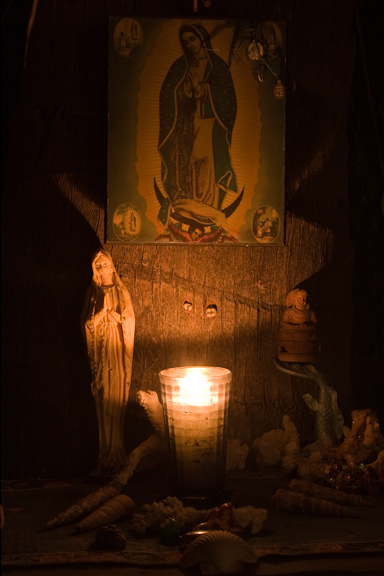
That was our introduction to Warren Harrison, known to everyone in Maruata simply as Warry. Warry and his wife Sherry Tice had been spending six months every year in Mexico, most of it camped right where they were in the compound overseen by Don Elodio and Martina. Their home was a converted special education school bus surrounded by all kinds of paraphenelia making up an outdoor kithcen and dinng area, a shrine to the Virgin of Guadalupe, and photographs and memorabilia that summed up their lives. 
Don Elodio, 87, on his horse
Martina


Warren and Sherry in Maruata
Warry had a robust figure, but obviously limited use of his right arm, stemming he said from a motorcycle accident which had almost taken his life years before. In spite of this slight handicap, every day Warry donned a wet suit, weights, and mask and took his spear down to the beach and went swimming for several hours. He seldom if ever returned without bringing two or three large fish with him. These he gave to his hosts or other people in the village, keeping only enough to feed him and Sherry, and occasionally those, like us, lucky enough to be his guests. As a result he was loved by everyone in the village. It didn't hurt that Sherry made friends with many of the women in the village, even leading classes in aerobics and belly dancing, sharing cooking ideas, and just helping out in any way she could think of. 


Warry's Shrine to the Virgin of Guadalupe
Warry loved to talk and tell stories. He had a colorful past, including a brush with the feds when, as captain of a fishing boat out of New Bedford, Massachusetts, he was asked by the boat's owner to pick up a "special cargo" at some point out in the Atlantic. In another adventure Warry had ridden a motorcycle across Europe and Asia. His favorite country was Afghanistan, where Warry had traded rifles with a tribal chieftan. Warry called Afghanistan the last bastion of free people.

Getting to know Warry and Sherry was a big part of what made Maruata special for us. We spent many wonderful candle lit evenings sitting around the table outside their bus telling tales and discussing the state of the world. Warry's political views could probably best be described as libertarian. He was a strong believer in indvidual effort and self-reliance, and his life mirrored his beliefs. While he had little faith in “society” or government, he seemed to love everyone he met, and he was loved in return.

Kocapelli, the fluteplayer
Three years ago we learned from Sherry that they were no longer going to Mexico. We wondered what change of health or circumstances had brought about the change in life style, but we didn't ask. A few days ago we received this email from Sherry (abridged):

“My husband, of 30 years passed away yesterday, Sunday, March 3, 2013. He was a wonderful man who lived a wonderful life. Those who knew him, loved him. He touched many lives & helped many people. He was a lover of humanity. Up until 3 years ago, life was very full for him & he was in love with it. Three years ago he went into a deep depression that he was unable to let go of. Yesterday I returned home from a conference & found him lying in the driveway with a bullet in his head. I will always love him dearly. People have asked, "Is there anything we might do for you? My reply is, Yes you can love yourself unconditionally & share that love with everyone--ALL of God's creation--& hopefully it will help keep someone else from putting a bullet in their head. Warren loved everyone. He could not stop thinking of all who suffer in this world & all the deceptions & cruelties & injustices--man's general inhumanity to his brothers & sisters. He said he no longer wanted to live on this planet. His solution was a loss for us all. To all that loved him, please know that I share in YOUR grief as well. Love, Sherry.”

I can only add, Love the life you have, live it to the fullest, and be kind to your fellow creatures. Let that be our tribute to the Warry's of the world.

Sunset at Maruata


 Click here to read our earlier post on Maruata.